
Ready to dive into the classics?
Master Classical Chinese—Read Ancient Texts with confidence!
A complete, university-level introduction to Classical/Literary Chinese—designed for non-native and heritage learners.
Comprehensive Online Course, just $299
Outlier products are used and recommended at:
Check out a sample lesson below!
Sample Lesson
Lesson 1:
The Analects of Confucius
This is Lesson 1 of Michael Fuller’s excellent An Introduction to Literary Chinese. We’ll be using the 2nd Edition, but the 1st Edition is also perfectly fine.
Texts:
Traditional Characters
Text 1:
孔子曰,
生而知之者,上也。
學而知之者,次也。
困而學之,又次也。
困而不學,民斯爲下矣。
Text 2:
子曰,孟之反不伐。
奔而殿,將入門,策其馬,
曰,非敢後也,馬不進也。
Simplified Characters
Text 1:
孔子曰,
生而知之者,上也。
学而知之者,次也。
困而学之,又次也。
困而不学,民斯为下矣。
Text 2:
子曰,孟之反不伐。
奔而殿,将入门,策其马,
曰,非敢后也,马不进也。

What it is
A 16-lesson guided introduction to reading Classical Chinese. Intended for lower intermediate Chinese learners and above, following Michael Fuller's An Introduction to Literary Chinese.
This is equivalent to a semester-long university-level course!
You also get access to regular live Q&A sessions.
By the end, you'll have a solid grasp of the fundamentals of reading classical Chinese, and will be able to read basic texts yourself (and know which resources to use if you get stuck).
Who is it for?
Serious Chinese Students
Anyone who wants to reach a high level in Chinese will benefit from this course. Modern formal writing (newspapers, contracts, professional and academic documents, etc.) draws heavily from Classical Chinese, so it's not just for historians!
Non-native and heritage speakers
The way a non-native should go about learning Classical/Literary Chinese is very different from the way a native speaker should. It's very difficult to find instruction in Classical Chinese for non-natives without enrolling in university courses—until now!
Busy Adults & Lifelong Learners
The course is entirely self-paced, and like all of our courses, you'll still be able to access all of the materials after we're finished. No need to stress about time—you can go through the lessons on your own time, and ask us for help whenever you need it!
Curriculum
Part I: Basic Grammar
Lesson 1: Nominal and Verbal Sentences (論語・困學)
Lesson 2: Parts of Speech (韓非子・宋國富人)
Lesson 3: Coordinate Verbs (韓非子・守株待兔)
Lesson 4: The Modifier 所 and Nominalized Verbs (呂氏春秋・刻舟求劍)
Lesson 5: Negatives (韓非子・矛盾)
Lesson 6: Pivot Verbs, Auxiliary Verbs, and Classical Commentary (列子・楊布)
Lesson 7: Coverbs (戰國策・狐假虎威)
Lesson 8: Embedded Sentences (孟子・揠苗)
Part II: Intermediate Texts
Lesson 9: 說苑・晉平公問於師曠
Lesson 10: 新序・兩頭蛇
Lesson 11: 戰國策・曾參殺人
Lesson 12: 說苑・趙簡子問子貢
Lesson 13: 戰國策・趙簡子舉兵攻齊
Lesson 14: 莊子・鵷鶵
Lesson 15: 莊子・曳尾於塗中
Lesson 16: 史記・石奢
Learn Classical Chinese through Real Classical Texts!
Learn Classical Chinese Through Real Texts
Learn with John Renfroe, who has taught Classical Chinese to nearly 500 people, using Michael Fuller's excellent textbook, An Introduction to Literary Chinese.
100% risk free - 30 day money back guarantee

Here's what you get:
16 unedited excerpts from real classical texts
Sentence-by-sentence vocab and grammar explanations
Exercises with each lesson to deepen your understanding
Regular live sessions with John
A community of other classical Chinese learners
Lifetime access to all course materials and replays
Just $299
What you get with this course
Read Authentic Classical Texts
Confucius, Mencius, Zhuangzi, and more
Improve Your Modern Chinese
Classical structures appear everywhere in Mandarin
Understand Historical Context
Grasp the language behind China’s literary tradition
Step-by-Step Lessons
From basic grammar to advanced commentary
Live Q&A Sessions
Ask your questions directly and get answers
Certificate of Completion
Demonstrates mastery for further study
See why learners can’t get enough
We’ve helped hundreds of students learn Classical Chinese more effectively. Here’s what they say:
These classical Chinese courses were right up my alley as I'm more interested in older Chinese culture vs. modern-day (and reading vs speaking), but incidentally force me to learn some modern Chinese along the way!
Peter W.
Margreet B.
Chris L.
I did learn to read some 古文 and 文言文 in the Taiwanese education system growing up. However, the method of teaching is purely chalk and talk. The teacher read the text, read out the translation in 白話 and we copy it down. The teacher would point out a sentence that is a 倒裝句 and the meaning of a peculiar or unusual vocabulary for us to memorise. That is the extent of teaching and learning of 古文/文言文 in my time. Consequently, I would have a hard time trying to understand a new 古文/文言文 text on my own for years until I took the Intro to CC course. Thank you John Renfroe and Ash Henson. I am very grateful for the courses as well as the teaching and expert knowledge provided.
Susan C. (native Mandarin speaker)
Meet Your Teacher
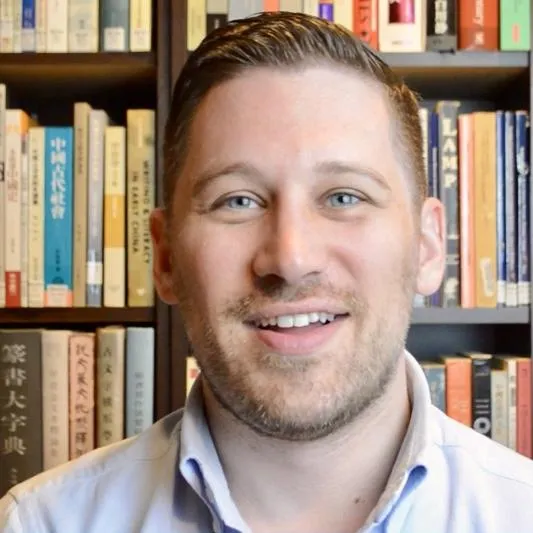
John Renfroe
Co-founder & CEO
Before co-founding Outlier, John studied Linguistics and Paleography in the Graduate Institute of Chinese at National Taiwan Normal University. He co-founded and later ran the Taipei Classical Chinese Reading Group, a weekly reading group consisting mostly of graduate Sinology students from western universities. He also taught classical Chinese to members of the group who had no previous instruction in the language. His coursework and research focused on excavated Warring States bamboo texts, historical Chinese character morphology, and the Shuowen Jiezi 說文解字 and its commentaries and criticism.
Frequently Asked Questions
Can I go at my own pace? Will I be able to access the course once I've finished it?
Yes! You get lifetime access, so we'll keep everything available online so that you can go through it at your own pace and review it whenever you want to!
How much Chinese do I need to know to take this course?
You'll need to be at a lower-intermediate level. Generally, if you're somewhere in the HSK 2-3 range, or TOCFL 2-ish, you should be fine. The course will be taught in English, and while we will use some references in Chinese, translations will be provided so that you won't get lost. If you're not sure about your level, get in touch!
How long does the course take to complete?
There are 16 lessons. We'll be releasing 1 lesson per week, but you can go at whatever pace suits you!
How much time will it require per lesson?
That will depend on your level, but probably a few hours per lesson. The course is structured like a university Classical Chinese course for non-natives, so that should give you a guideline as to how much time you'll need.
Each video lesson will be about 30 minutes long. You'll also get access to regular "office hours" on Zoom, so you can pop in and ask questions if you'd like. There's also a discussion forum, so if you can't make it to the office hours, you can still get your questions answered.
Will I need anything (apps, etc.) in order to take the course?
Only the textbook is required, but having access to a few other materials will be very helpful—digital versions are available for most items. You don't need more than one of the dictionaries on the list, although having more than one certainly won't hurt. The course also includes bibliographic exercises, and we'll provide photocopies when necessary.
- An Introduction to Literary Chinese by Michael Fuller (required; I'll be teaching from the 2nd Edition but either edition is fine)
- Outline of Classical Chinese Grammar by Edwin Pulleyblank (highly recommended)
- A Student's Dictionary of Classical and Medieval Chinese by Paul W. Kroll (highly recommended; available in Pleco)
- 《古漢語常用字字典》 (highly recommended)
- 《古漢語大辭典》 (recommended; available in Pleco)
- 《漢語大詞典》 (recommended; available in Pleco)
What does "lifetime access" mean?
In practical terms, it means the course materials will be available online for as long as Outlier is in business. If we do ever go out of business or otherwise need to remove the course for any reason, we'll make the material available for you to download for a period of at least 6 months.
Will the course be in simplified or traditional characters?
The textbook uses traditional characters, but I'll be supplying the readings (which are public domain) in simplified characters as well. If you're only familiar with simplified, this (plus maybe jotting down simplified characters in the margins of the book where needed) should be enough, although if you'd like to also start learning traditional, maybe this would be a good time!
Can I get a refund if I decide the course isn't for me?
Yes! We have a 30-day, no questions asked refund policy. If you decide you don't like the course for whatever reason, just reach out by then and I'll be happy to give you a full refund.
Will there be assignments or homework?
There are several types of exercises (grammar, translation, bibliographic, etc.) in the textbook, so we'll be doing those. I'll also be adding some additional exercises, particularly in Unit 2. We'll have a "final exam" at the end of the course, and a passing grade will get you a certificate.
Will there be other students at my level? Can we collaborate with other students or form study groups?
Definitely! There are plenty of students at all levels in the course.
And sure, working together is no problem! You'll get access to a private online community where you can work together, ask questions, share notes, etc.
I don't know Mandarin, but I know Japanese/Korean/Cantonese. Can I join?
First, take a look at this paragraph from the preface of the textbook:
"The vocabulary lists for the lessons use the pīnyīn romanization of Mandarin Chinese, a choice that deserves some comment. On the whole, given the great distance between the ancient language and the modern dialects, the modern pronunciation of the characters is of little significance. The textbook does assume some knowledge of Chinese characters as used in a modern East Asian language, but it makes no real difference if the language is Mandarin, Cantonese, Japanese, or Korean. Indeed, it is important to remember that the corpus of texts written in "literary Chinese" is more accurately an east Asian textual tradition and that the elites of pre-modern Korea, Japan, and Vietnam were both familiar with the authors whose works have been selected for this textbook and used literary Chinese as the primary medium for serious writing. Literary Chinese thus has a much wider audience than just speakers of modern Mandarin."
So strictly speaking, you don't need to know Mandarin in order to take the course, but it will probably require some extra effort on your part, since only Mandarin readings of the characters are given in the textbook.
That being said, quite a few people have taken the course who don't know Mandarin at all, and it's been no problem.
Also, keep in mind that when I give examples during the lectures and Q&As, I'll pronounce them in Mandarin. But if that doesn't bother you and you can follow along, filling in the pronunciation in your language of choice, then there shouldn't be any reason that you can't take the course.
Copyright © 2026 Outlier Linguistics - All Rights Reserved