Kanji Radicals in Japanese. Don’t Do It.
Why you need to start thinking of kanji in terms offunctional components.
This advice is going to rub some people the wrong way, but that’s alright. We’re on a mission to teach you Japaneseproperly– not to rehash the way “things have always been done.”
Hopefully by the end of the article you’ll understand why I say this.
Kanji radicals have a single purpose: indexing kanji in a dictionary.
They are not designed to help you learn Japanese kanji, and they are not the building blocks of kanji. There, I said it.
Radicals are not designed for people to learn kanji
There’s a huge misconception about how kanji work. You see this sort of advice all the time: “Kanji are made up of radicals, so you should learn the radicals first,” or “Make sure you learn the radicals. They’re the building blocks of kanji characters.”
This isnottrue.
People who say this are well-intentioned but ill-informed about the nature of the kanji.
Let’s take a look at the difference between kanji radicals and functional components.
Start by knowing what a radical is
The word “radical” is best understood as “a kanji component that sometimes plays theroleof radical,” NOT “a kanji component that has thenatureof being a radical”.
For example, 大 【ダイ】 “big” is a component that is on the list of radicals, but that doesn’t mean that 大 isalwaysa radical when it appears in a kanji. A single kanji only has one radical, no matter how many kanjicomponentsit has.
And since the choice of which component will play the role of radical is up to the editor of a given dictionary, it may be different in different dictionaries—and may differ between Chinese and Japanese! That’s because a radical’s role is to organize dictionaries,notto explain kanji structure!
And yes, many of the components on the list of radicals do show up a lot in kanji and therefore should be learned, but they should be learned as part of a system offunctional components— components which express sound and meaning.
Just memorizing common radicals or radical names is going to leave you lost without a path towards literacy.
Radicals are for dictionary creators and users
So, if you’re talking about radicals, the conversation should focus on dictionary lookup. If you’re talking about how kanji work, or about etymology, then it should be about semantic components and sound components. Getting the terminology straight helps to prevent confusing statements like “radicals are the building blocks of kanji.” They're not. Functional components are.
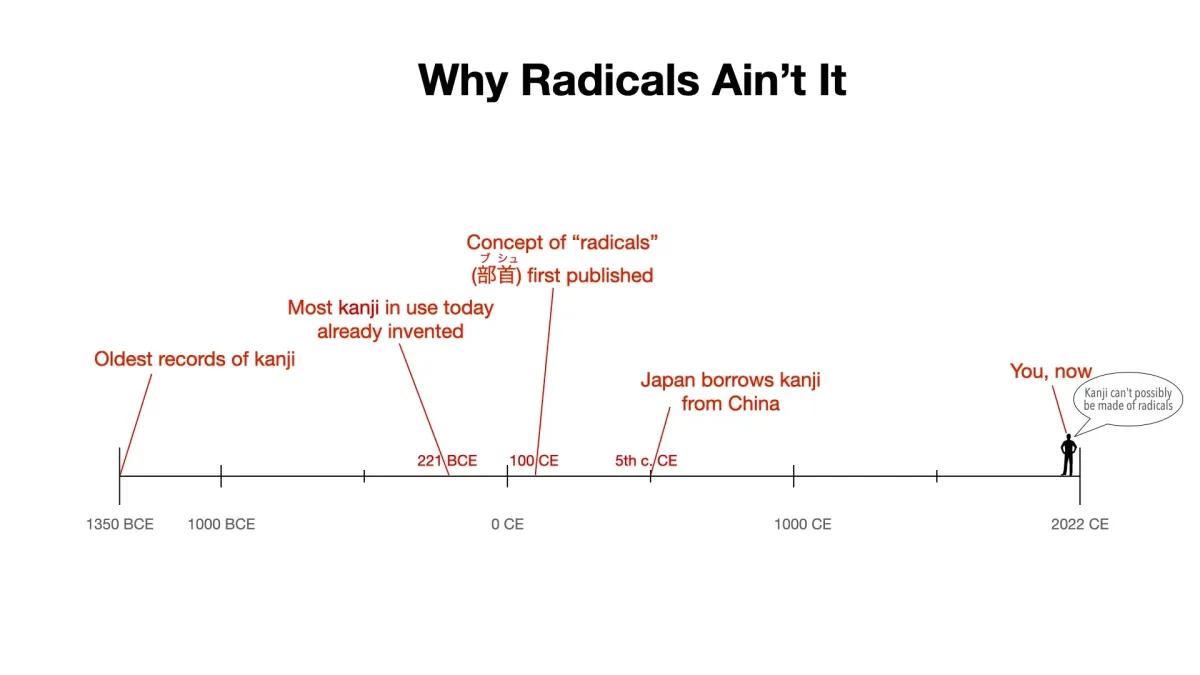
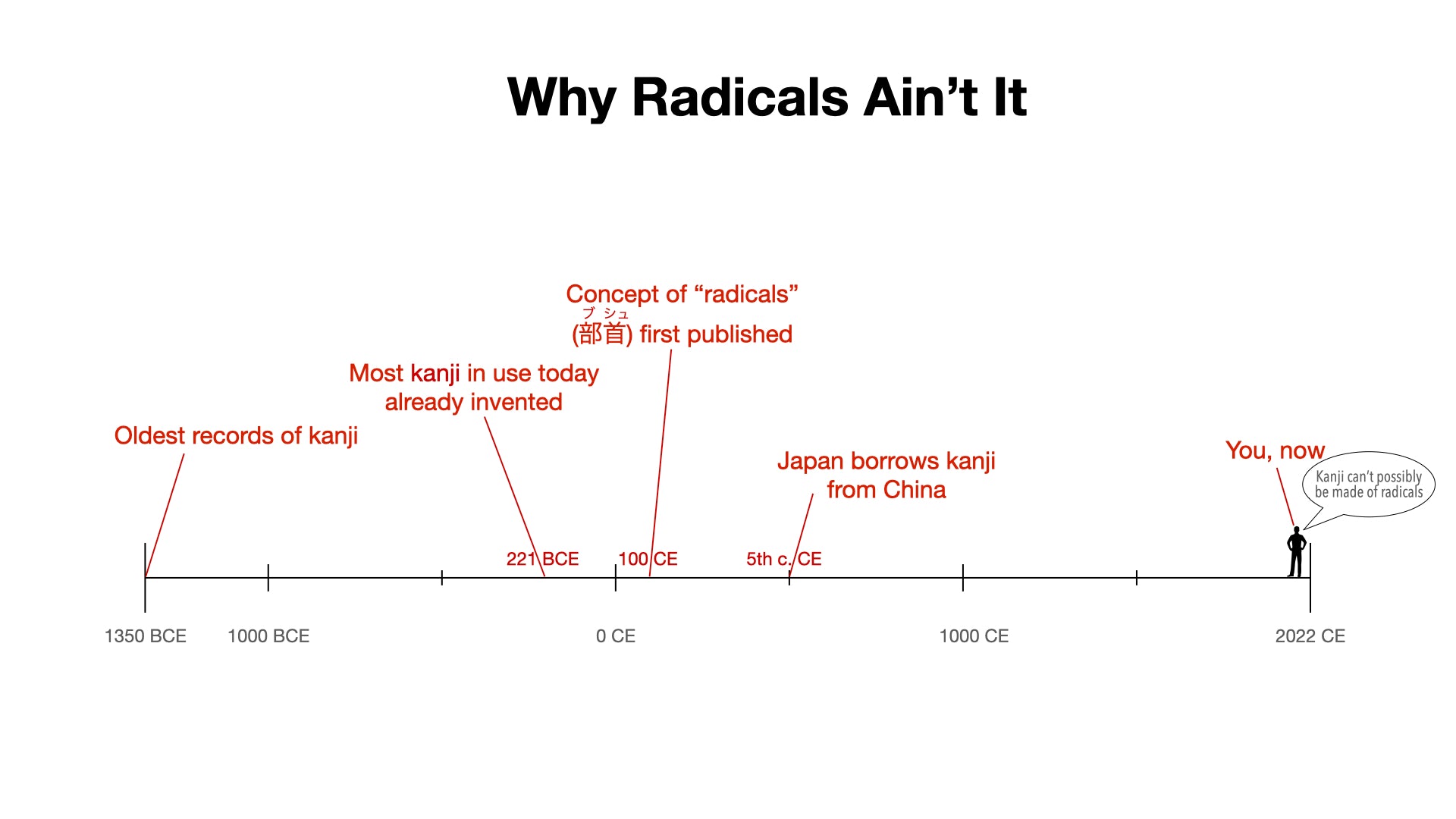
The concept of radical, or 部首 【ブシュ】 (bushu), didn’t even exist until after the publication of theSetsumon Kaiji(説文解字 【セツモンカイジ】; Shuōwén Jiězì in Chinese) in 100 CE, at which point the writing system had already been around for well over 1500 years. The vast majority of kanji in use today were inventedbefore the Setsumon was published.
Read that again and let it sink in.
If that’s the case, then there’s no way that “radicals” were what people had in mind when they were creating kanji, because radicals didn’t even exist yet! There must have been something else going on.
“There’s no way that radicals were what people had in mind when they were creating kanji.”
The word “radical” is really a poor translation into English of the Japanese (actually, Chinese) word 部首 【ブシュ】 in the first place.Bushuliterally means “section head.” Following the model of theSetsumon, kanji dictionaries are traditionally arranged into sections containing similar graphic components. These sections are called 部 【ブ】. The first kanji in that section is the sectionhead(部首 【ブシュ】), or the “first of the section.”
Each kanji in that section is filed under thatbushu. Note that I didn’t say the kanji “has” one 部首. It’s an important distinction to make. The kanji is filed under a 部 【ブ】, or section. This is a choice made by the editor of a kanji dictionary, not an inherent part of the nature of kanji.
Think about it—usually when you see a kanji’s radical listed, you’ll also see a stroke count. In a dictionary entry for 家, you’ll likely see “宀 + 7” in the dictionary (side note: 宀 is often called ウかんむりu kanmuribecause it sort of looks like the katakana ウ). This is because traditionally-arranged Japanese language dictionaries would first sort kanji by radical, and then by stroke count or stroke order. So if you know the stroke order of the kanji you’re looking for, and can guess at which radical it might be filed under, then you’ll have an easier time finding that kanji in a dictionary.
Which section to file a kanji under can be a fairly arbitrary decision. Most people’s understanding is that thebushugives a hint about meaning, and that the sound component (声符 【セイフ】) gives a hint about the sound, and that the two are different entities. But that’s not always the case!
Sometimes, thebushuis the sound component. For example, 刂 (刀 【トウ】, “knife”) on the right side of 到 【トウ】 “to arrive” is both the sound component and the radical in 到, but it isnotthe meaning component. 至 【シ】 (the component on the left side of 到) is the meaning component, and it means “to arrive,” just like 到. Intuitively, you might think that radicals are assigned in a consistent manner, but sometimes the way they’re assigned can be pretty random, as we've seen.
Note that while 刂 and 刀 may look like different radicals, they are actually variants of each other—many radicals have one or more variants that are considered to be essentially the same radical.
You might be thinking, “Sure, there are exceptions, but kanji radicals areusuallyrelated to the meaning of the kanji!” But actually, that’s only true about 64% of the time. That means that in 36% of kanji, the radical isnotrelated to meaning. Would you ask a friend for driving directions if you knew he gets lost 36% of the time? I wouldn’t!
So again, kanji are filed into a given section. This is a choice made by a human being, not an inherent part of the nature of kanji, and it’s a flawed — but workable — system.
So hopefully, you can see that “radicals” (remember: section headings!) are useful for organizing and looking things up in a dictionary, but they’re not especially useful for explaining how kanji work.
Introducing a better way: functional components
You should look at all Japanese kanji in terms of theirfunctional components. These are the real building blocks of kanji, because they’re how kanji were originally designed in the first place!
Kanji components can serve a few different functions, and you need to understand those functions instead of lumping them all under one category called “radicals,” as most people do.
There are three attributes that all kanji have (using 大 as an example):
Form: What is it a picture of? 大 is a picture of a person (specifically, an adult).
Meaning: What does it mean? 大 means big, because adults are big in comparison to children.
Sound: What is its pronunciation? (Or, if it’s a sound component, what is the range of sounds it can represent?) 大 is pronounced ダイdaiin Japanese
Note that I'm usingonyomihere and in the rest of the article, since those readings are the only ones that are relevant when discussing sound components—remember, kanji came from Chinese, so the sound relationships don’t work forkunyomiwords, which are native to the Japanese language.
The possible functions that a component can have derive directly from these three attributes. Let’s take a look at those functions now, and you’ll see how much sense it makes to learn the functional components that make up a kanji, rather than thinking in terms of radicals.
Three primary functions of functional components
Form Components
A component can expressmeaning by way of itsform.
Example: 大 is a picture of a person, and that is its function in, for example, the kanji for “beautiful” 美 【ビ】. 美 isnota “big” 大 “sheep” 羊, but a depiction of a person 大 wearing a headdress (the headdress 𦍌 nowresembles羊, but it's unrelated). This is by far the most common way of expressing meaning.
Other examples of 大 functioning in this way include:
天 【テン】 “heavens” (originally “person with a mark indicating the forehead”)
夫 【フ】 “husband, man”
Meaning Components
A component can expressmeaning by way ofmeaning. Example: 大 means “big,” and it expresses the meaning “big” in kanji like 尖. This is how most people explainallsemantic components, but in realitythis function is much less common!
尖
Form: “small” over “big”
Meaning: “sharp”
Sound: センsen
As for why “small” over “big” means “sharp,” take a look:

Sound Components
A component can expresssound. Example: 大 is pronounced 【ダイ】daiin Japanese, and it’s the sound component in the kanji 太【タイ】tai“great, large”.
Then there is a fourth function that derives from the way kanji evolved in form over time. A component can also serve as a placeholder for an earlier form that has now beencorrupted.
This one is difficult to figure out without academic training in paleography, but theOutlier Kanji Dictionaryexplains which components have been corrupted and how. Continuing with 大 as an example, there are 1) instances in which a component was originally 大 but has now changed to something else, and 2) instances in which a component started as something else but has corrupted to look like 大 today. That means you can’t trust your eyes—you need a reliable source to tell you what’s what!
The sound component in 達 is 𦍒 【タツ、ダ】tatsu, da. The top part today looks like 土 【ド、ト】 “earth,” but it was originally 大, which was then corrupted over time. An uncorrupted version of this component would look like 羍 today.1
The form above is written in small seal script (小篆【ショウテン】). This is what 大, 土, and 達 looked like in small seal, for comparison:

In the kanji 莫【バク、ボ】 (“do not,” but it originally represented the word “sunset,” which is now written 暮【ボ】), what today looks like 大 on the bottom was originally 艸 【ソウ】 “grass” (there was 艸 on both the top and bottom, and the kanji depicted the sun setting behind the grass), which then corrupted over time to look like 大.
So now you’ve seen how the same component can serve completely different functions in different kanji, and how components can become corrupted over time, obscuring their original purpose. Here’s the interesting thing: out of the kanji I’ve just discussed, 大 is only the radical in 天, 夫, and 太. In the others, it’s not a radical, no matter which function it’s serving! The radical in the other kanji is:
尖:小
美:羊
達:辶
莫:艹
It’s important to note that which side of a kanji a component shows up on haszero bearingon what its function is. There are some general trends, but lots of exceptions! So whether a component is on the right side or the left side of a kanji, you need a little help from a resource like theOutlier Kanji Dictionaryto help you figure out what the kanji’s real structure is!
Summary
Again, all this is not to say that you should completely throw radicals out the window. They’re good to know, but you should keep in mind what they’re used for: looking up kanji in traditionally-arranged dictionaries. That’s it. They’re not the “building blocks of kanji.” Functional components are! Radicals are an imperfect, man-made system of arranging and looking up kanji in a dictionary. The concept of 部首 didn’t even exist when the vast majority of kanji were being created.
Butsound and semantic componentsdidexist. Sound and semantic componentsarethe building blocks of kanji. Sound and semantic components are what people were thinking of whenever they made a new kanji. When you’re learning a new kanji, thinking in terms of these functional components (rather than radicals) will clarify a lot of confusing things about kanji, and help you a lot with the memorization you need to do in order to learn all of the jōyō kanji. And whether you enjoy using flashcards or mnemonics (or both!) to learn kanji, you’ll find that learning theirreal structurevia functional components will make it much easier to get through that list of kanji you need to memorize!
Anything that tries to explain kanji and uses terms like “dotted cliff radical” or “water radical” is going to be inaccurate and (unintentionally) leading you astray.
𦍒 is also a semantic component. 达 is a picture of a guy walking across the road. The original meaning was “arrive at point b from point a”. 達 is the same thing, but has a guy leading a sheep from point A to point B.↩
